Bounce Houses for Back-to-School Events: What Works Best for Schools and PTOs
Back-to-school season brings North Georgia school communities together for welcome-back nights, PTO celebrations, and family gatherings. Bounce house rentals for school events need to accommodate multiple grade levels, larger crowds, and tight schedules that work around dismissal and campus activities.
The best choice isn't the biggest inflatable available—it's the one that fits your school's space, expected attendance, age groups, and event flow. Here's what schools and PTOs around Cleveland, Gainesville, and Clarkesville should consider.
📋 Table of Contents
- Why Bounce Houses Work Well for Welcome-Back Events
- Start With the Crowd, Not the Bounce House
- Plan Lines and Rotations Before the Event Starts
- Choose Bounce Houses With Mixed Grade Levels in Mind
- Match the Inflatable to the Available School Space
- Think About the Entire Event Layout
- Work Setup Timing Around the School Day
- Build Safety Coordination Into the Plan
- Keep the Event Simple Enough to Manage
- Make the Decision as a Team
Which type of school event are you planning?
50-150 families — One or two grade levels, shorter event window, intimate gathering feel. Focus on simple setup and easy volunteer coordination.
150-400 families — Multiple grades, mixed ages, longer event duration. Need activity zones, line management, and age-appropriate inflatable options.
400+ families — Large-scale community gathering with food, vendors, and multiple attractions. Require strategic placement, volunteer teams, and coordinated setup timing.
Why Bounce Houses Work Well for Welcome-Back Events
A good back-to-school event needs activities that don't require much explanation.
Bounce houses check that box. Kids can recognize the activity as soon as they arrive, while organizers can incorporate the inflatable into a larger event with food, games, tables, and other attractions.
That flexibility is particularly useful for schools around Cleveland, Gainesville, Clarkesville, and other North Georgia communities where welcome-back events can range from smaller PTO gatherings to larger family nights.
💡 Pro Tip: Inflatables can help give an event structure. Instead of hundreds of guests moving toward one central activity, create different zones—one section with bounce houses, another with food or concessions, and another with games or seating.
Start With the Crowd, Not the Bounce House
It can be tempting to start by scrolling through inflatables and picking the one that looks the most exciting.
For a school or PTO event, start with the people instead.
Questions to Answer Before Choosing an Inflatable:
- How many families are expected?
- Which grades are invited?
- Will younger and older students attend at the same time?
- How long will the event last?
- Are families likely to arrive together or gradually?
- What other activities will compete for students' attention?
A smaller elementary school gathering has different needs from an event serving several hundred students and family members.
Expected attendance doesn't necessarily tell you exactly how many inflatables you'll need, either. What matters is how many children are likely to want to participate at the same time and how guests will move between activities.
That brings us to one of the biggest considerations for higher-traffic events: lines.
Plan Lines and Rotations Before the Event Starts
Nobody wants the welcome-back celebration to become a welcome-back waiting line.
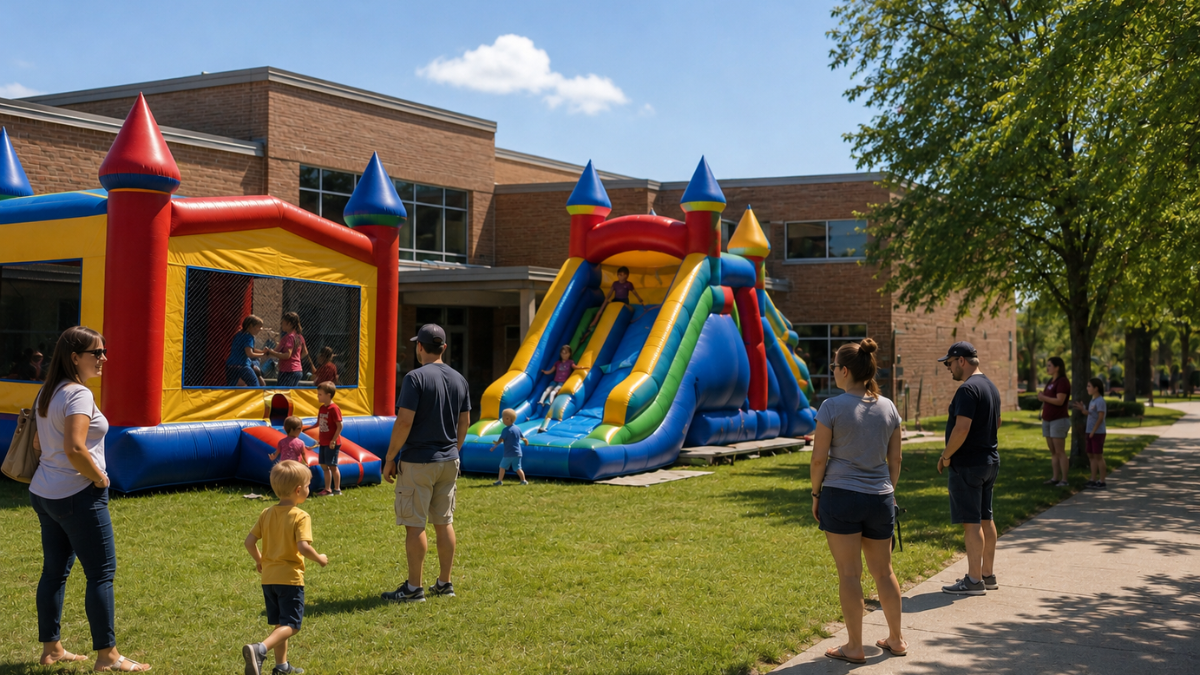
For PTO event bounce house rentals, organizers should think about traffic flow before deciding where each inflatable goes.
↓ What Keeps Lines Moving
- Multiple inflatables spread across the event area
- Clear entrance and exit paths
- Waiting areas that don't block walkways
- Grade-level rotations during peak times
- Volunteers managing turn-taking
- Other attractions competing for attention
↑ What Creates Bottlenecks
- One inflatable for all age groups
- Inflatables placed too close together
- Lines crossing food service areas
- No volunteer coordination plan
- Entry/exit paths that overlap
- Limited alternative activities
Look at where children will enter and exit the activity, where waiting guests can stand, and whether those lines could interfere with food areas, walkways, entrances, or other attractions.
The important part is having a plan before families arrive. A little organization can make a busy event feel much easier to manage.
Choose Bounce Houses With Mixed Grade Levels in Mind
A kindergarten student and a fifth grader can have very different ideas about what makes an inflatable exciting.
That's why age-group planning matters for school welcome parties.
If an event includes a wide range of grades, placing every child into one activity group may not create the best experience. Younger children can sometimes feel overwhelmed around bigger, faster-moving students, while older kids may want something more challenging than a basic jumping area.
Age-Appropriate Activity Zones
Traditional bounce houses with open jumping areas. Bright colors, recognizable themes, easy entry and exit.
Combo units or obstacle challenges with more active elements. Climbing, sliding, interactive features.
Competitive obstacle courses or interactive game inflatables. Challenge-based activities with more complexity.
Schools can instead think in terms of activity zones. A traditional bounce house may work well for younger students, while older children may enjoy a larger combo unit or another active attraction.
💡 Pro Tip: Separating activities doesn't have to make the event complicated. It can actually make choices clearer for families while helping organizers create a more comfortable flow for different age groups.
Match the Inflatable to the Available School Space
School properties can offer plenty of room, but not every open-looking area is automatically appropriate for an inflatable.
Before booking, identify the areas being considered and get a clear picture of the usable space.
Think beyond width and length.
Space Considerations Beyond Square Footage:
- Surrounding setup area — Inflatables need buffer space around all sides
- Overhead clearance — Tree branches, power lines, building overhangs
- Access for delivery and setup — Can trucks reach the area?
- Nearby buildings or equipment — Avoid placement too close to structures
- How families will walk around the attraction — Natural foot traffic patterns
The location should make sense within the overall event rather than forcing everything else to work around the inflatable.
This is one reason communicating with the rental company early can be helpful. Providing information about the school property and planned event area makes it easier to narrow the choices before the PTO or event committee commits to a particular setup.
Think About the Entire Event Layout
The inflatable is only one piece of a school event.
Parents may need somewhere to sit. Volunteers need room to work. Food or concessions need their own area. Families need clear paths between activities.
Instead of deciding where the bounce house goes in isolation, sketch out the event as a whole.
Simple Event Layout Map Should Include:
✓ Inflatable areas
✓ Waiting areas
✓ Food and drink stations
✓ Tables and seating
✓ Entrances and exits
✓ Volunteer stations
✓ Other games and activities
✓ Parking and drop-off
✓ Restroom access
Keeping high-traffic attractions from competing for the same patch of space can make the gathering easier for both families and volunteers.
Work Setup Timing Around the School Day
Timing can be one of the biggest differences between a school event and a private party.
A PTO might have access to the event area only after dismissal. Buses may need to clear certain sections first. Staff may be leaving while volunteers are arriving. After-school programs or sports practices may still be happening elsewhere on campus.
That's why setup timing should be discussed before event day.
⚠️ Timing Coordination: Schools should determine when the event area becomes accessible and communicate any restrictions that could affect delivery or setup.
Useful information: School dismissal time, bus traffic patterns, available setup windows, locked gates or restricted access points, after-school activities using nearby areas, and the event's official start and end times.
The more everyone understands the schedule beforehand, the easier it is to coordinate the setup around an already busy school day.
Build Safety Coordination Into the Plan
Safety at a school event is a shared planning responsibility.
Schools and PTOs should know who will be responsible for the inflatable area during the event and how that responsibility fits into the larger volunteer plan.
Rather than figuring it out once students are already lining up, establish responsibilities beforehand.
Before the Event
✓ Assign volunteers to activity areas
✓ Communicate participation expectations to families
✓ Review weather forecast and have backup plan
✓ Confirm rental company safety protocols
During the Event
✓ Volunteers monitor activity areas
✓ Manage capacity and turn-taking
✓ Watch for weather changes
✓ Address concerns as they arise
Weather should also remain part of the conversation, particularly during August in North Georgia. Hot conditions can affect how an outdoor event feels, even when everything else is running smoothly.
The goal isn't to make a school celebration feel restrictive. It's to create enough structure that everyone can concentrate on having a good time.
Keep the Event Simple Enough to Manage
It's easy for PTO committees to keep adding ideas.
One bounce house becomes three. Then somebody suggests another game. Then food. Then a fundraiser. Then a theme.
Before long, the welcome-back event has turned into a miniature festival.
🚨 Non-Negotiable: More isn't always better. A few well-chosen attractions with a clear layout can create a better experience than filling every available corner of the school property.
Think about what the event is actually supposed to accomplish.
For most back-to-school gatherings, the goal is connection: giving students a fun way to see friends again, helping new families feel welcome, and creating an easy setting for the school community to spend time together.
Choose rentals that support that goal instead of competing with it.
Make the Decision as a Team
School and PTO planning often involves several people, which can be helpful—as long as everyone is evaluating the same things.
Before comparing inflatable options, agree on the basics:
Expected attendance: How many families are realistically coming?
Student ages: Which grades need to be accommodated?
Available space: Where can inflatables actually be placed?
Event schedule: How much time is available for setup and the event itself?
Other activities: What else will be happening nearby?
Volunteer plan: Who will help manage different areas?
Once those questions are answered, selecting the right bounce house becomes much easier.
Rather than asking, "Which inflatable looks best?" the committee can ask, "Which option works best for this particular event?"
That's a much more useful question.
Frequently Asked Questions
Planning a Back-to-School Event in North Georgia?
Back-to-school celebrations don't need to feel complicated to be memorable. For schools and PTOs in Cleveland, Gainesville, Clarkesville, and surrounding North Georgia communities, the right inflatable setup starts with understanding your event.
Think about the students attending, the available space, how lines will move, when setup can happen, and how volunteers will coordinate the activity areas. Those decisions can help create a welcome-back event that feels organized while still giving kids plenty of room to have fun.
Book Online NowNo pressure, no pitch — just helpful planning for your school community.